Two Stages
So I performed on two very different stages this last weekend.
Hauling my instruments across the bridge in the wind and rain to Chez Paradise wasn’t pleasant, but we had to practice at least once before we headed down to Longtan to play a show in the large covered square in front of Longyuan Temple. Practice? you say incredulously. Yes, dear reader, although we usually wouldn’t need to go to such extremes, the Ramblers were down three players this game, as Cristina, Zach and Thumper were all off in distant lands, frolicking with familial folks and whatnot. We called upon the Auxiliary Rambler Forces, namely Sylvain and Hu Chun, who have come to our aid several times in the past, to fill in. But we needed to practice. I’d thought I was running late, but it turned out that I was the first to arrive (after David, who is house-sitting at Le Chez). Slim was under the weather and didn’t appear for another couple of hours, but he was looking sharp (if tired) when he did.
Our driver Mr. Gao, top-knot well-coifed as usual, met us in the alley; we packed into his van and headed down the jam-packed highway. Soundcheck was at 4:30, and we were met in front of the temple by Chenbl’s “Little Aunt” (his mother’s youngest sister), who is herself a famous street singer in Longtan. Her nickname is Xiao Long Nu (小龍女), known for her melodious singing voice. Everyone remarked at the family resemblance, not just in looks but in singing voice; Chenbl also loves to sing and is quite good as well…his aunt told us, “Chenbl was always singing Teresa Teng songs as a kid!” which is eminently believable. David, being the coffee aficionado that he is, had sniffed out the best coffee stand at the street market in front of the temple, so I joined him in sampling tasty some ice coffee, along with a cinnamon bun from a neighboring stall.
We went through soundcheck for all our instruments; I had clip-on mics for my trumpet and baritone, and the bass mic was booming nicely. We had to wrap up quickly as the gods, upon their palanquins and accompanied by lion dancers and various high-level officials, were returning, their imminent arrival heralded by the usual fury of fireworks. We had some time before the show, so I threw caution to the winds and left my umbrella in the temple green room, setting out for a stroll up the street and around the eponymous lake of Longtan where people were paying to take dragon boat rides across the water under the big white bridge. I took a detour through a covered side market when it started raining again, by an old camera shop whose window contained the same camera that we had when I was growing up, an Argus Seventy-Five. It was the first camera I ever knew, and one which I was always walking around the house with, looking down through the glass viewfinder. When I got around to researching it, I found that it was actually not that great a camera, but I had fun with it before I got my own camera (a Pentax K1000) when I was 15.
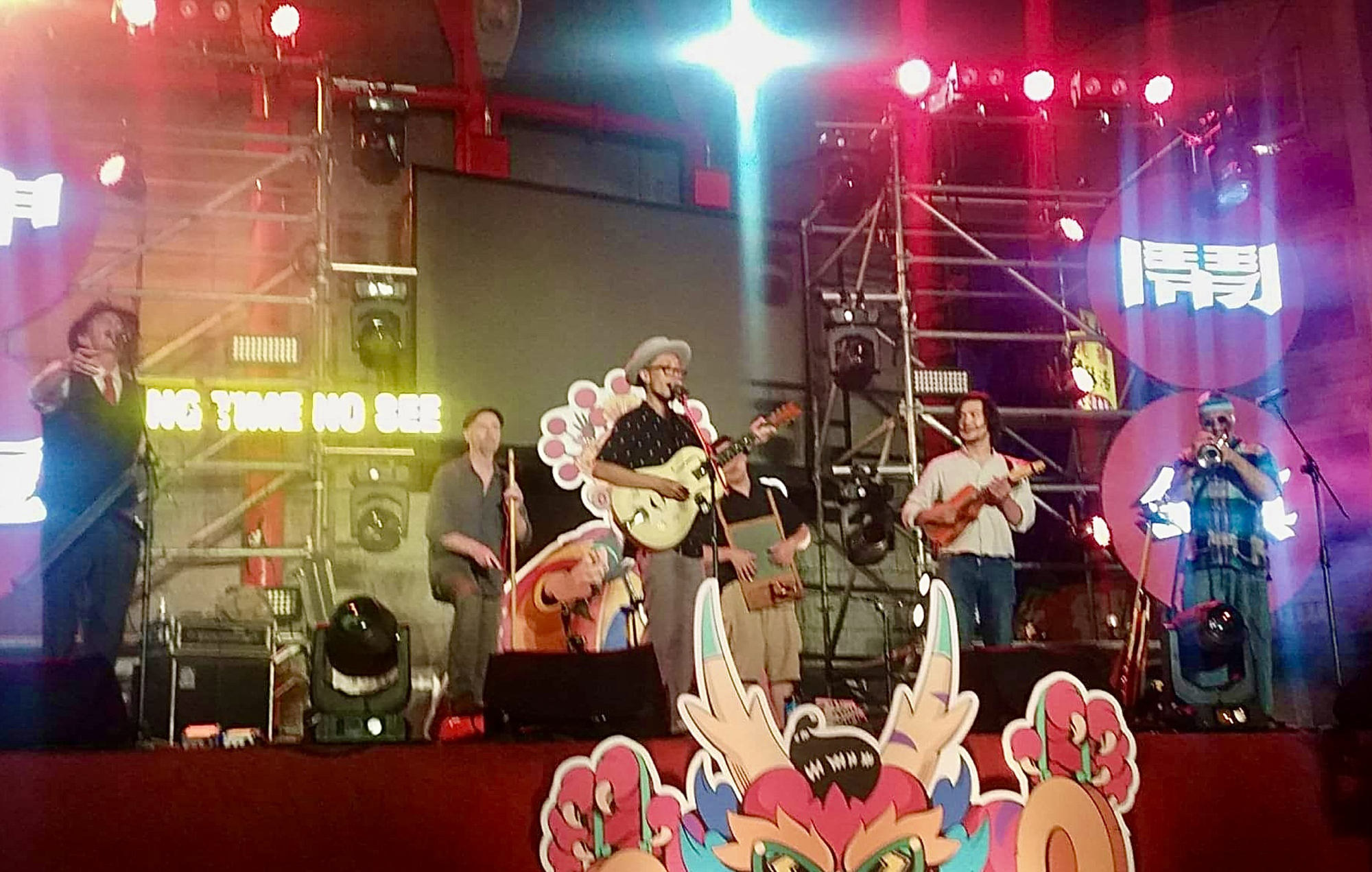 Our show was supposed to start at 8:30, but the stage was full of Very Important Politicians/lion dancers, so we didn’t get on stage until a little later, and our show was cut so short I didn’t even play the baritone, and the trumpet for just one song (At least they didn’t cut our pay). Chenbl’s aunt sat in the front-row section reserved for Very Important People (“Everyone here knows me,” she said, and I believe her), making videos and taking selfies with us in the background, and the crowd seemed to really enjoy the music. And while we were still the Muddy Basin Ramblers, it was a rather different experience minus the missing members…softer, less raucous. Not worse, just different. Sylvain and Hu Chun played wonderfully, of course, but you can’t replace saxophone and violin with guitar and mandolin and expect the same sound.
Mr. Gao whisked us back to Xindian much more quickly after traffic had died down in the late evening, though it was still raining. I hauled my gear back to the Water Curtain Cave and went straight to bed. It had been quite a day.
Then I woke up on Sunday morning and wondered if the comedy show was going down.
Allow me to provide a little background: A couple of weeks ago I saw a post on one of the VR groups I belong to, inviting people to attend a VR recreation of the famous improv comedy show “Whose Line Is It Anyway?” called, imaginatively and no doubt for copyright reasons, “Whose Turn Is It Anyhow?” I’ve long been a fan of the show, so last Sunday morning I showed up at the space in Meta Horizon Worlds, and while talking with the organizers, was invited on stage to participate. I demurred at first, wanting to see exactly what they were doing, and although some of the younger participants had, uh, questionable taste in their choice of jokes, it was actually an interesting experiment. So when they asked me again if I wanted to go on stage, I said ok.
And I gotta say, it was a blast. They organized mostly the same games as the show, with four players on stage, and while there were some technical issues, it went pretty well. I had to really think about what I was going to say, but also react quickly. The organizers and the audience both seemed to like what I was doing and invited me back. I said we’ll see.
So, back to Sunday morning, just out of bed after a long day in Longtan, drinking coffee to revive and recover: I thought, I need to take it easy today, but…what the hell, let’s see what they’re doing. I went back to the space, inviting my friend Sean, who also grew up in Florida, and immediately felt a little foolish when we arrived as the place was empty. “I guess they’re not doing it?” I said, disappointed, thinking, but it had been such a good idea.
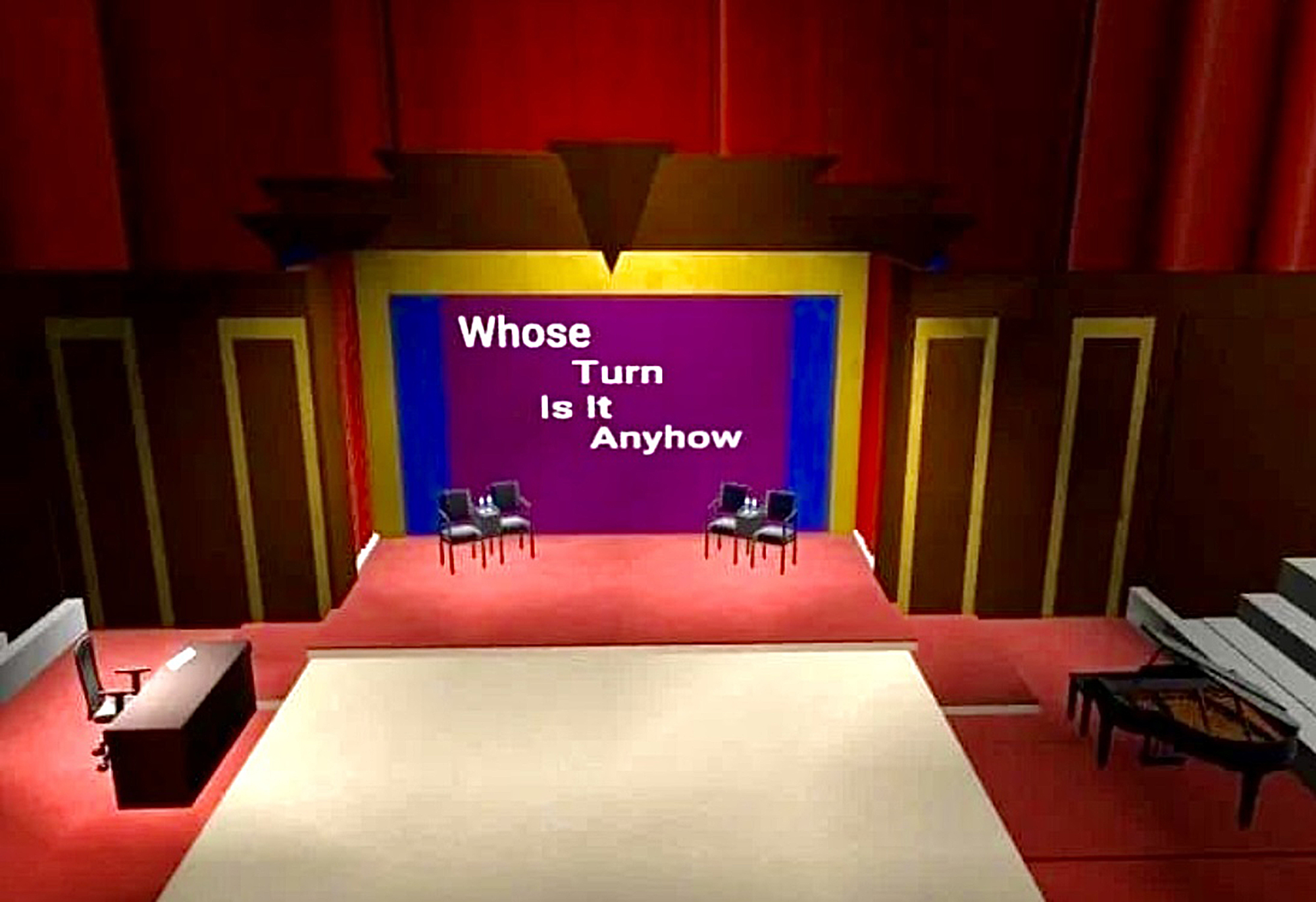 Then a bunch of avatars popped in and waved to us. “You’re in the wrong instance! We’re at the new space!” Oh, ok. We ported to the new space, and it was full of people. I was curious to see if the first time had been a fluke, but no; I spent the next couple of hours on stage doing improv with the other three players, and again, it was SO much fun. We did the alphabet game, the bachelor game, and Questions Only, where I was a little too good, leaving my partner stranded on the sidelines for nearly the entire time (That was rude of me btw; I will try not to do that in the future). The organizers had wanted to do Props, but the mechanics were wonky so they held off on that one, which is a shame as that’s one of my favorite Whose Line games. One of the player’s native language wasn’t English, but despite being out of the loop regarding certain cultural references, she did a great job. The room stayed maxxed out (which isn’t saying a whole lot as the Meta Horizon rooms are only able to hold 30-something people), but someone was streaming it on Tik Tok, so there was that. The jokes definitely got more than a little risqué, and I’m sure that the Meta staff were “observing” the space, but at no point did anyone get out of hand or disrespectful. Horizons is the best place for that kind of thing, due to the fact that the Meta avatars are better and more animated than avatars in other spaces (so far…we’ll see what happens when Apple really gets into the game; their first attempt at a headset, the Vision Pro is already amazing in so many ways, not least of all price). The way my mind works, I have been thinking of better versions of what I said on stage, which is a little concerning, but then again, probably better to be fixated on that than my usual array of anxieties.
People have told me they could never get on stage in front of people, and I get it. Slim, as animated as he usually is on the stage, is always muttering “Heebie jeebies!” before shows, even though we’ve been doing this kind of thing for literally decades. I don’t really get that nervous in either case, but it was interesting to compare the two experiences. I actually felt more exposed on the VR comedy stage than I did on the real life musical stage. Perhaps that is because I’m used to playing music on stage and more or less know what I’m doing, whereas I’d never actually done improv before this. There are also many common elements between the two, e.g. reacting to other players, coming up with new lines, responding to the audience, timing, volume, tone, etc. Both leave me feeling emotionally drained and high at the same time, weirdly.
Perhaps in the future, as more of our lives move towards online experiences, and virtual and actual worlds meld into each other with MR and AR development, the whole concept of “being on stage” will evolve into something entirely different than how we think of it now. Certainly with the disappearance of “mainstream” media as the defining factor in what and whom we chose to engage with, the way we move socially in any space is being redefined.
There is of course the potential for all of this to devolve into a massive dumpster fire, but then again it might actually bring people closer together. In any case, it should be interesting to see where all of this goes.